
Chemicals · Production scheduling
Production scheduling software for chemical manufacturers.
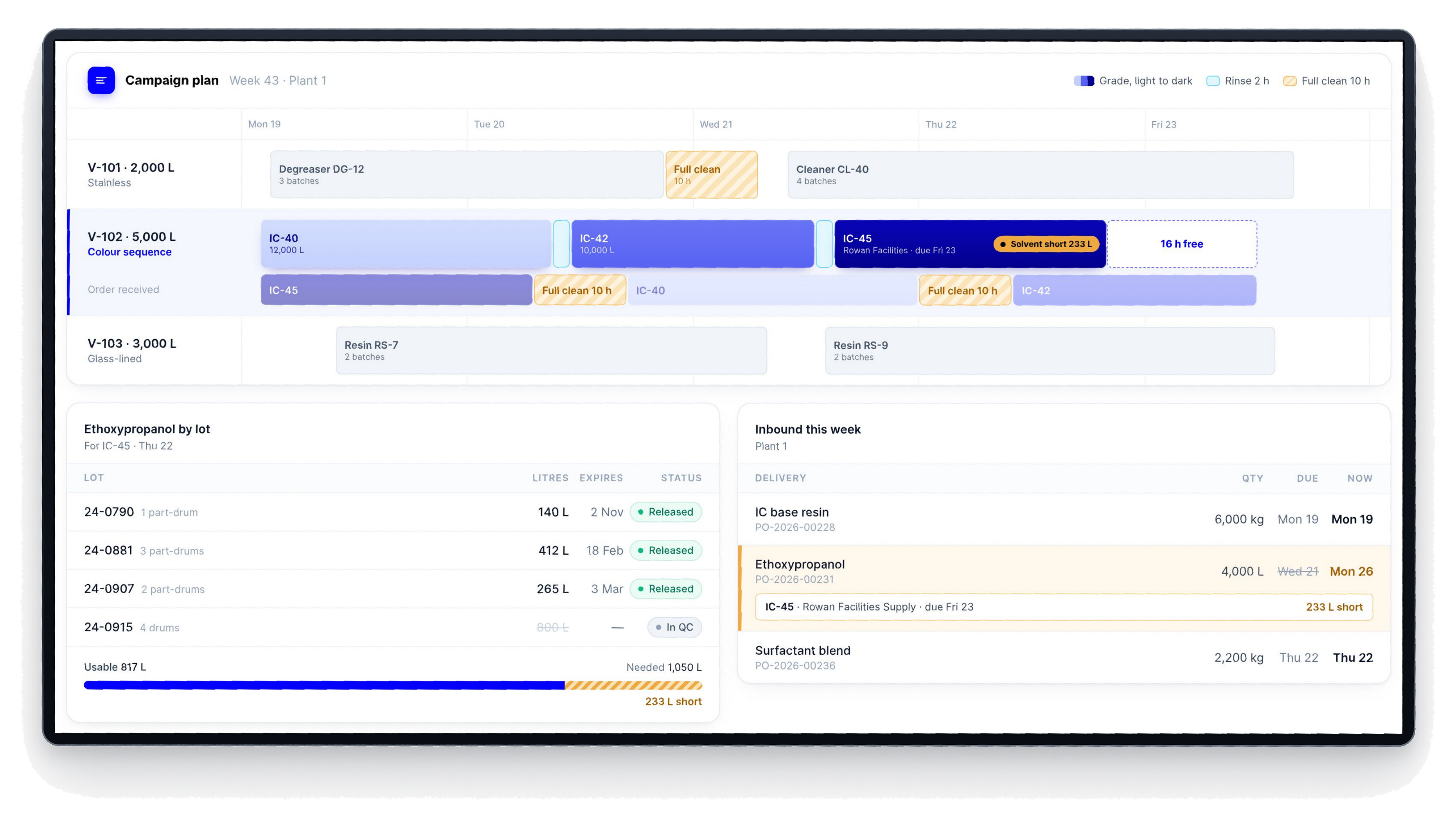
Production scheduling software for chemical manufacturers. Plan batches and campaigns by vessel, with cleaning, hazard compatibility, released lots and supplier dates checked before the plan is promised.
Today
The vessel plan works until a lot fails QC or a solvent delivery slips, then the whole campaign is rebuilt by hand.
Generic scheduling tools treat a reactor like any machine. Chemical batches depend on vessel size, cleaning between products, hazard compatibility, charge weights, released lots and supplier dates, all at once.
With Worldover
Worldover's production scheduling sequences batches and campaigns by vessel, using approved formulas, usable lot stock, supplier dates, cleaning rules and hazard data from the same record as MRP, quality and ERP.
Campaigns run in an order that minimises cleaning and waiting, and customer dates are promised against a schedule the plant can actually hold.
The products behind the operation
Your operational core and specialist systems, connected.
Specialist depth for every team, working on the same materials, products, orders and batches. No planning tools bolted onto a product database. No generic ERP with formulation hidden in an attachment.
This is one example of a connected system. It's an MRP campaign plan, and it can only be built this way because company, stock, product, regulatory and formulation data all sit on the same system. The schedule knows which lots are released and usable, what each approved formula and packaging BOM needs, and which obligations apply to the product being made. That's what turns a calendar of vessels into a plan the factory can run.
One workflow, end to end
A delayed solvent delivery
The difference isn't another isolated tool. It's the same work running from one live record.
Where work breaks
Cleaning and compatibility live in people's heads
Which products can follow which in a vessel, and how long the clean takes, isn't in the tool, so the schedule ignores the biggest source of lost time.
The schedule can't see lot status
A batch is slotted while its raw material is still waiting on a CoA or held by QC, so the vessel sits idle on the day.
Campaigns are rebuilt by hand
A rush order or late delivery moves several batches across vessels, and the planner reworks the spreadsheet while dispatch dates go stale.
- 01
A supplier pushes a solvent delivery back four days.
- 02
Today: planning works out which batches use it, checks other vessels by phone and reshuffles the campaign in a spreadsheet.
- 03
In Worldover: the scheduler shows every batch that needs the solvent, the usable stock already on site and which vessels are free.
- 04
Cleaning time and hazard compatibility are applied to the alternative sequence automatically.
- 05
The planner approves the new campaign order and affected customer dates update with it.
With Worldover
- 1
Batches come from orders and MRP
Each batch carries its approved formula, charge weights, expected yield and due date.
- 2
Readiness is checked before a slot
Raw material lots, part-drums and IBCs are checked for availability, CoA status and QC release against the planned date.
- 3
Vessels, cleaning and compatibility are modelled
Vessel capacity, cleaning time and which products can follow which shape the campaign sequence.
- 4
Changes re-plan in one place
Moving a batch shows every downstream batch, vessel and dispatch date it affects before anyone confirms it.
Connected inside Worldover
One product workflow.Every consequence connected.
Scheduling from the substance record means hazard classes, cleaning requirements and lot status come from the same data as the formula and SDS, so the campaign order respects the chemistry without a separate lookup.
Willow
Useful AI starts with live operational context.
Scoped permissions, human approval for anything material and a full audit trail of every action.
- Which batches this week aren't ready to run, and what's blocking each one?
- Suggest a campaign order for reactor 3 that keeps cleaning time to a minimum.
- If the solvent arrives on Friday, which dispatch dates change?
Buyer confidence
A specialist system, without a specialist-system rollout.
Worldover combines detailed operational control with a practical route to a live first phase.
- 125+
- Enterprise customers across cosmetics, chemicals and supplements
- 4 to 7
- Point systems typically retired, most within 6 months of go-live
- 12 to 16 weeks
- To a live Phase 1, not a multi-year programme
- 1 record
- Per substance, everywhere it appears
Buyer questions
Choosing production scheduling software for chemical manufacturers.
What should production scheduling software for chemical manufacturers include?
It should cover job sequencing by line or vessel, changeovers, material readiness and quality status, and keep charge weights, yields, CoAs and SDS versions on the same record. Worldover connects this to the rest of the operation, so nobody re-keys data between systems.
How long does it take to go live?
Most teams reach a live Phase 1 in 12 to 16 weeks. We agree which workflows, products and data move first, then expand from there rather than running a multi-year programme.
Can it replace our spreadsheets or current system?
Yes, that's usually where teams start. We move the records and workflows that matter first, and you can keep an existing system running alongside Worldover where it still does a defined job.
Does it connect to our accounting and other tools?
Yes. You can keep your finance system and agree which records and transactions it exchanges with Worldover. The connections are scoped around how your team actually works.
How is pricing worked out?
Pricing depends on the products you use, the size of your team and the scope of the first phase. We'll give you a clear quote after a short scoping call.
See it on your operation
Book a 30-minute demo
Give us the essentials, then choose a 30-minute slot directly in the right person’s calendar. We’ll use your workflow, products and documents, not a generic slide deck.