
Ingredient providers · Cosmetics
Cosmetic ingredient supplier software, from sample to sale.
Worldover connects PLM, R&D, regulatory and CRM for cosmetic ingredient suppliers. Keep grades, specifications, application trials, samples and customer document packs on one record, so technical answers don't get lost in handovers.
Without Worldover
A formulator asks how your ingredient behaves in their emulsion, and the proof is a mock formulation nobody has written down properly.
Application development runs across hundreds of projects at once: data, testing, formulation creation, customer interaction, samples and sign-off, mostly outside any system.
- The lab is a revenue function here, because the mock formulation is what makes the customer buy, yet it's the least supported part of the business.
- Composition with ranges, exact percentages and impurities at ppm is maintained by hand, then copied into every document.
- Regulatory, quality and commercial each assemble their own version of the same customer dossier.
Formulators wait days for an answer your lab already found last year, and the customer buys from whoever replies first.
With Worldover
Worldover connects the applications lab, INCI mapping across markets, samples, technical documentation and the customer request in one record.
Technical selling stops depending on who remembers the last trial.
- One lab record covers raw materials, application formulations, trials, tests and samples, so past work is searchable rather than remembered.
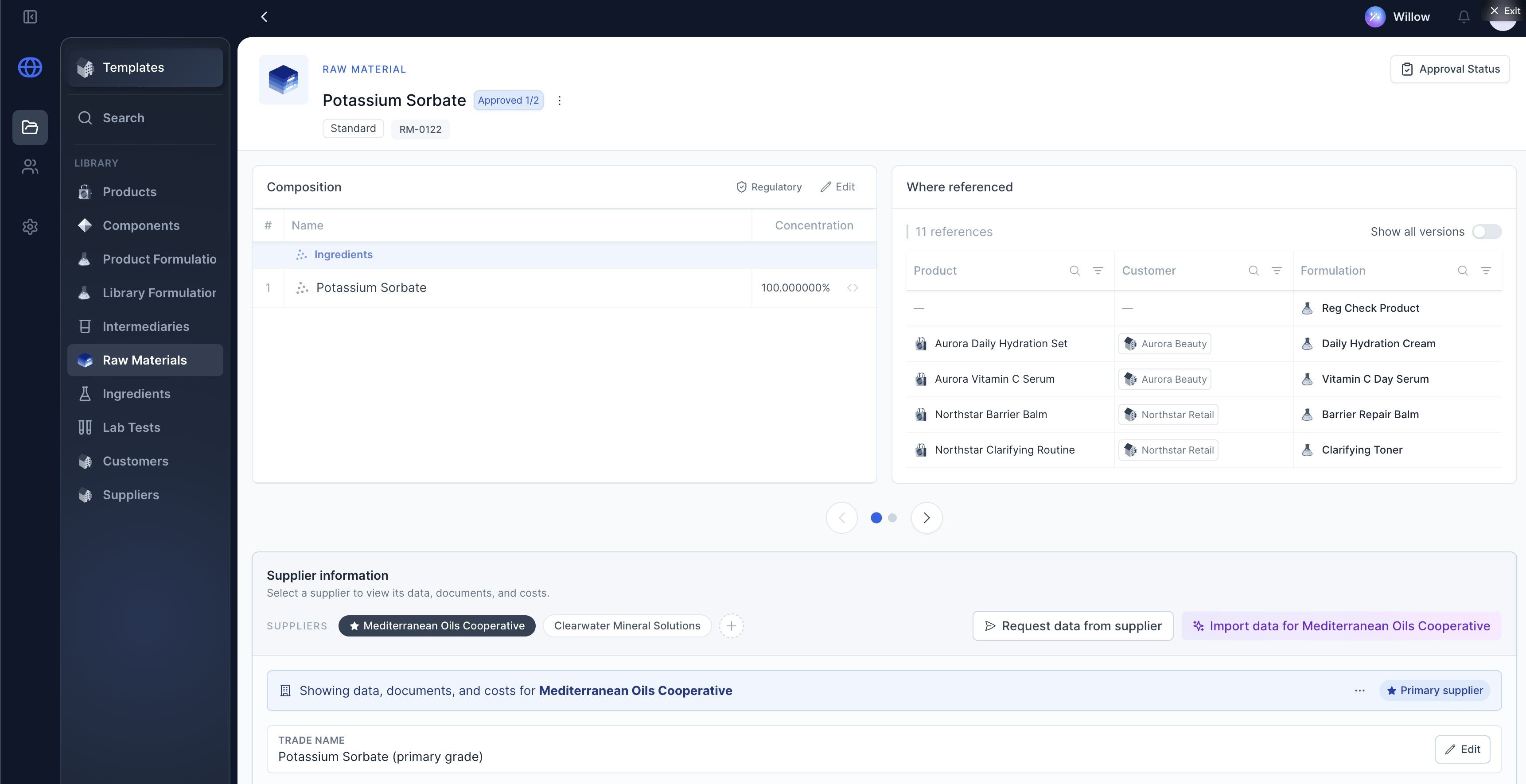
- INCI mapping per market, composition ranges and impurities at ppm are held once and reused in every document.
- Technical data sheets, allergen and nanomaterial statements and heavy metals data are generated from the live record.
Build your setup
These are the modules we typicallyoffer to cosmetics ingredient providers.
Ingredient and chemicals producers lead with SDS authoring and the applications lab, because documentation and technical support are what actually sell the portfolio.
Starting from operations. We've pre-selected the modules that function runs on. Add or remove anything below.
R&D / PLM
The product and formulation foundation. Where most customers start, because everything else reads from it.
SDS Authoring
Every chemical that changes hands needs an SDS, in the end user's language, across every jurisdiction. Generate and version them automatically.
See it for cosmetics ingredient providersR&D Lab Software
The applications lab gets a home: raw materials, compositions with impurities at ppm, trials, tests and INCI mapping across markets.
See it for cosmetics ingredient providersQMS
Specifications, supplier approval, deviations, CAPA with effectiveness verification, and training records, which are the two most commonly failed audit items.
- Training
- Auto-reminders
- Document control
Customer Portals
Ends the document relay. Customers pull the SDS, CoA, statements and declarations themselves, under permission control.
See it for cosmetics ingredient providersPLM
The portfolio represented accurately, with every associated document and composition attached to the product.
See it for cosmetics ingredient providersTesting Management
Protocols, results and approvals feeding batch release, including third-party results that currently live outside the system.
See it for cosmetics ingredient providersAI Agents
Two-way document flow automated: chase supplier paperwork, extract and file it, then generate the packs customers ask for.
Add to your setupMRP / MES
Making and moving the product. Batch execution, planning, stock and the warehouse.
MES
Electronic batch records across mixing and finishing, with lot traceability you can prove in hours.
- Electronic batch records
- Three-level order structure
- Dual-signature control
Inventory Management
A catalogue-wide view of stock, with tiered supplier pricing history and scorecards behind every buying decision.
- Inventory overview
- Stock and non-stock items
- Request stock
Warehouse Management
Lot and location tracking through the site, with scanned receiving, picking and dispatch.
- Location management
- Receiving and putaway
- Pick, pack and dispatch
Production Planning
Vessel and line capacity, sequencing to minimise cleaning, and consolidation of customer orders into efficient batches.
Add to your setupDemand Planning
Forecasting and sales velocity feeding production planning.
Only if: Customer forecasts drive your plant, which is usually where the chaos starts.
Add to your setupERP
The financial backbone, running on the same substance-aware records.
ERP
Finance and order management on the same substance-aware records.
- General ledger
- Accounts payable
- Accounts receivable
FP&A
Budgets, forecasts, variance analysis and scenario planning.
Only if: You're managing margin per material and reporting to a group or a board.
See it for cosmetics ingredient providersYour setup
Inventory Management + MES + Warehouse Management + QMS + ERP
What it connects
Work orders, in-process checks, yield, deviations and the stock the batch becomes.
How the workflow changes
Yield is reconciled at the batch, not at month end. Quality holds and releases move stock status directly, so nobody ships against a spreadsheet that's a day out of date.
Scope note
No molecule discovery, drug discovery or scientific simulation.
Take this setup with you
Get your setup as a PDF.
The modules you've selected, what each one covers and how they connect, written up as a document you can share internally.
Worldover supports application development, formulation, technical service, product data and commercialisation. It doesn't sell fundamental scientific discovery.
Worldover supports connected regulatory workflows, product documentation, approvals and the operational data behind them. It isn't a regulatory consultancy service.
Willow finds answers, prepares work and routes decisions using the live operating record. Material actions remain governed by permissions, approvals and audit history.
5 selected
See your setupWillow
The AI colleague insideyour cosmetics ingredient provider operation.
Because every workflow you pick above writes to one connected operating record, Willow can work from what's actually true today, not a copy of it.
Reads
Answers questions from your live formulas, documents, batches and customers.
Writes
Updates the record itself, drafting the formulation change or document and writing it back with its source and version.
Prepares
Drafts the document, the update or the reply so a person only has to check it.
Gets approved
Scoped permissions, human approval for anything material and a full audit trail of every action.
- 125+
- Enterprise customers across cosmetics, chemicals and supplements
- 4 to 7
- Point systems typically retired, most within 6 months of go-live
- 12 to 16 weeks
- To a live Phase 1, not a multi-year programme
- 1 record
- Per substance, everywhere it appears
US biotech ingredient provider
Debut Biotech
We implemented PLM as the system of record for every novel active, with R&D drawing straight from the same library. Retrieval that took hours now takes minutes.
Read Debut Biotech's customer storyResearch
Compared with the alternatives
If you're still building a shortlist, these break the market down side by side.
- ShortlistBest cosmetics ERPs in 2026How the main cosmetics ERPs compare on formulation, batch and regulatory depth.Read it
- ShortlistBest regulatory compliance software for cosmetics in 2026PIF, CPSR, CPNP, SCPN and MoCRA coverage compared across the market.Read it
- GuideSDS authoring software buyer's guideWhat separates real SDS authoring from document templating.Read it
- ComparisonWorldover vs spreadsheets and shared drivesThe real cost of the stack most teams are still running.Read it
Book a 30-minute slot
Tell us where the friction sits today and we'll map the Worldover setup that removes it.
Common questions
What cosmetics ingredient provider teamsask us most.
The questions that come up in nearly every conversation
How many jurisdictions does SDS authoring cover?
Authoring is multi-language and multi-jurisdiction, generated from composition and classification held once, with full version control and distribution history per customer.
Can it handle ranges, exact percentages and impurities?
Yes. Composition management supports ranges, exact percentages and impurities at ppm, and reuses that data across every document generated from it.
What happens when the SVHC candidate list updates?
You can see which materials, mixtures and customers are affected from the substance data you already hold, rather than starting a manual review.
Does the applications lab get its own workspace?
Yes. Mock and application formulations, trials, tests and samples run on the same record the commercial team works from, so technical answers reach the customer faster.
Cosmetics ingredient providers: the questions people search
- Can ingredient supplier software connect samples and customer documents?
- Yes. Worldover links sample requests, application trials and customer enquiries to the ingredient grade, specification and supporting documents. Technical and sales teams can prepare a response from the same current record.
- How do we choose software for cosmetic ingredient suppliers?
- Check whether it holds grade-level specifications and evidence, connects samples and application trials to enquiries, and keeps customer document packs current. Order entry alone won't cover that technical work. Worldover connects PLM, R&D, regulatory and CRM around the ingredient.
- What software do cosmetic ingredient suppliers need?
- Cosmetic ingredient suppliers need a single specification and documentation record per grade, fast generation of customer document packs (specification, SDS, INCI, allergen, origin and regulatory statements), sample and demo formula management, and CRM linked to the technical record. Most of the workload is answering document requests, so document generation is the highest-value automation.
- How do you respond faster to customer regulatory questionnaires?
- You answer faster by holding each declaration (allergens, origin, animal testing, IFRA, prop 65, heavy metals) as structured data against the grade, so a questionnaire is assembled from the record instead of researched again. Suppliers doing this typically move from days to minutes per request.
- What documents do cosmetic ingredient customers ask for?
- Customers routinely ask for the technical data sheet, safety data sheet, certificate of analysis for the delivered lot, INCI and allergen declarations, origin and animal testing statements, regulatory status for their markets, and a demo formulation showing the ingredient in use.