MRP · Planning and production
Carry the plan into the batch.
A revised order, delayed delivery or changed yield stays connected to the affected jobs, material requirements and customer commitments.
Explore MRP
Manufacturers · Cosmetics
Worldover connects MRP and ERP for cosmetics manufacturers with R&D, PLM, quality and regulatory. Know what to make, what to buy and when you can deliver, from the approved formula to the released batch.
The brief landed yesterday. Whoever gets a credible sample back first usually takes the work.
Turning a brief into a formulation and a lab sample is manual, and it's running alongside hundreds of other projects, each with versions, revisions, testing and sign-off in different places.
You lose work to whoever samples faster, you can't take on more customers without hiring people who aren't available, and one failed audit can stop the site.
Worldover connects the enquiry, the customer formulation and its version history, qualified raw materials with live pricing, testing, capacity and the compliance screen in one workflow.
You can answer "can you make this, cheaper and better" before the brief goes cold.
MRP is the starting point, not the whole system
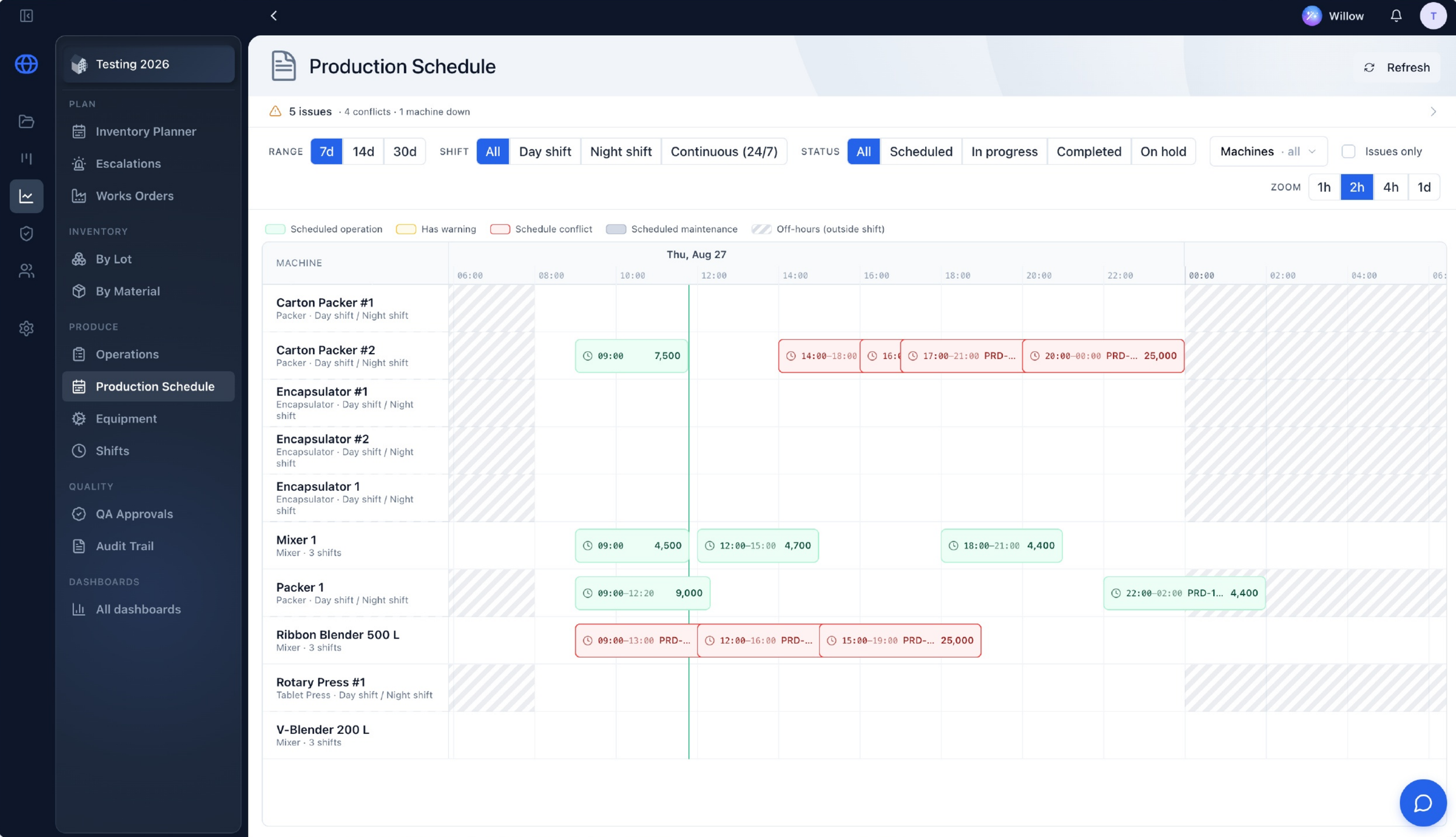
Plan bulk, filling and packing together. Worldover MRP connects approved formulas, raw materials, packaging, usable stock and line capacity, so a customer promise starts with a production plan that can actually run.
An order becomes a plan.
Orders and demand become production requirements from the approved formula and BOM. A revised order stays connected to the affected jobs and material requirements.
Stock and capacity are checked.
Usable stock, supplier lead times, equipment and shifts determine what's feasible, before you promise the date. A customer brings a launch forward. The bulk can be made, but the pump arrives later and the filling line is already committed. See the constraint before accepting the date, then review the purchasing and scheduling changes together.
Buying and production move together.
Purchase proposals and manufacturing jobs connect to the same customer commitment. Consumption and yields are recorded against the plan.
The batch earns its release.
QC evidence and release decisions stay linked to the batch and order. A completed batch isn't shippable until quality releases it.
MRP · Planning and production
A revised order, delayed delivery or changed yield stays connected to the affected jobs, material requirements and customer commitments.
Explore MRPERP · Orders, purchasing and inventory
A receipt doesn't make a quarantined lot available. Purchasing sees the shortfall, planning sees the constraint and sales can review the customer date. Keep your finance system where it makes sense.
Explore ERPBuild your setup
Start with MRP: production planning and inventory. Build the wider operation around it with ERP, batch execution, R&D, PLM, quality and regulatory. The same product and lot records follow the work from brief to released batch.
Making and moving the product. Batch execution, planning, stock and the warehouse.
AI-led scheduling across machines, labour, skills and material lead times, because an unoptimised whiteboard is idle capacity you're paying for.
Aggregated purchase proposals so you stop buying two 5kg packs of glycerin for two jobs, plus tiered pricing history and supplier scorecards.
Electronic batch records with dual signatures and staged QA release, replacing the paper record that delays every batch.
See it for cosmetics manufacturersThe product and formulation foundation. Where most customers start, because everything else reads from it.
Hundreds of customer formulations, each with versions, briefs and constant revisions, held on one record with real version history.
Raw materials, compositions, costs and regulatory screening in one lab record, so a brief becomes a costed, compliant sample faster than the competition.
A central costing matrix with BOM pricing, so "Box A or Box B, Cap A or Cap C" gets quoted accurately instead of guessed at.
Hundreds of NPD projects with tasks, critical paths and approvals sitting on the same data as the formulations.
Add to your setupStability, compatibility and PET results linked to the formulation, at scale, instead of a spreadsheet per project.
See it for cosmetics manufacturersYou get audited far more often than your customers do. Document control, training and CAPA with a full audit trail.
See it for cosmetics manufacturersAn enquiry-to-signed-customer pipeline that's actually connected to sampling, formulation and quoting.
See it for cosmetics manufacturersThe financial backbone, running on the same substance-aware records.
Ledger, AP, AR and order management running on the same batch and product records as the floor.
See it for cosmetics manufacturersBudgets, forecasts and variance analysis built from live operational cost.
Only if: You're reporting to a board or an owner who wants margin by customer and by job.
See it for cosmetics manufacturersYour setup
What it connects
Enquiries, bill of materials cost, live material prices, stock cover and the capacity to make it.
How the workflow changes
Quotes are built from the real BOM and the real schedule, so the promised price and the promised date survive contact with production instead of being renegotiated later.
Scope note
The manufacturing operation runs from customer demand through material planning, purchasing, production and quality release, with R&D, PLM and regulatory connected. Choose MRP for planning, ERP for transactions and costing, and QMS for release evidence.
Take this setup with you
Get your setup as a PDF.
The modules you've selected, what each one covers and how they connect, written up as a document you can share internally.
Worldover supports connected regulatory workflows, product documentation, approvals and the operational data behind them. It isn't a regulatory consultancy service.
Willow finds answers, prepares work and routes decisions using the live operating record. Material actions remain governed by permissions, approvals and audit history.
5 selected
See your setupWillow
Willow works from your orders, formulas, usable stock, supplier data and batches. It flags planning issues, prepares buying and production work, and helps quality and regulatory teams respond, with your people approving the decisions.
Checks the plan
Finds the material, capacity or release constraint behind an affected job or customer order.
Prepares the work
Prepares purchase proposals and manufacturing jobs from the current formula, usable stock and supplier context.
Connects the response
Drafts the QC follow-up, document update or customer reply against the affected records.
Gets approved
Scoped permissions, human approval for anything material and a full audit trail of every action.
US cosmetics contract manufacturer
“Then we met with Worldover, and the difference was very clear, these folks were thinking very differently about how to approach our business.”Read Elevation Labs's customer story
Tell us where the friction sits today and we'll map the Worldover setup that removes it.
Common questions
Version history is the point of the record. Every revision, who made it, what changed and which customer brief it answers stay attached to the formulation and to any documents generated from it.
Yes. Permissions are set per person and per record, and customer portals only expose the documents and projects belonging to that customer.
Records, certificates, batch evidence and sign-offs are held against the batch and the product, so customer and GMP audits are answered from the system rather than a folder hunt.
Yes. Most contract manufacturers start with the product record and the lab, then extend into planning, MES and warehouse once the front end is running.
Look for formula and packaging version control, lot inventory, material planning, batch records and quality release that work together. Worldover connects ERP and MRP to R&D, PLM, quality and regulatory, so the manufacturing plan uses the same approved product record as the rest of your team.
Yes, material planning, purchasing, production and inventory can run in Worldover alongside your formula, product and quality records. Agree the workflows and data that move in the first phase, and keep existing systems where they still serve a defined need.
Yes. Contract manufacturers can connect customer briefs, quotes and delivery commitments to the manufacturing job. Own-product manufacturers can manage their portfolio, formula changes and batch history on the same operating system.
Cosmetics manufacturers typically need formulation and PLM, MRP or ERP for planning and stock, quality management for batch release, and regulatory tooling for PIFs, CPNP or SCPN notifications and claims. Running them as separate systems forces the same formula, component and batch data to be re-keyed, which is why an operating system that holds one product record underneath all four is usually cheaper and faster than integrating four tools.
The Responsible Person keeps the PIF at their declared address for ten years after the last batch is placed on the market, containing the product description, signed CPSR, manufacturing method and GMP statement, claim substantiation and animal testing data. It stays valid only if it's regenerated from the live formula, supplier and label records rather than assembled once as a set of PDFs.
Electronic batch records replace spreadsheets by capturing the formula version, materials issued, in-process checks, deviations and release decision against the batch itself. The practical test is whether you can retrieve every batch made from one formula version, with its certificates of analysis, in seconds rather than reconstructing it from files.