MRP · Planning and production
Carry the plan into the batch.
A revised order, delayed delivery or changed yield stays connected to the affected jobs, material requirements and customer commitments.
Explore MRP
Manufacturers · Chemicals
Worldover connects MRP and ERP for chemical manufacturers with R&D, quality, regulatory and SDS authoring. Plan from usable stock, including part-drums of solvent, and keep charge weights, yields, QC results and CoAs tied to each batch.
The reactor ran, the yield came in under plan, and the SDS on the customer portal still describes last year's composition.
Composition, classification, cost per tonne, batch evidence and the documents you ship all move at different times, maintained by different people.
Margin per tonne stays unproven, documentation drifts from what you actually make, and a tonnage band or a restriction is discovered after it applies.
Worldover connects composition, classification and SDS output, live raw material cost, works orders, lot capture and yield on one record.
The document you ship and the batch you shipped describe the same thing.
MRP is the starting point, not the whole system
Plan campaigns, not just quantities. Worldover MRP connects released compositions, intermediates, usable lots, supplier lead times and vessel capacity, so purchasing and production work towards the same customer dates.
An order becomes a plan.
Orders and demand become production requirements from the approved formula and BOM. A revised order stays connected to the affected jobs and material requirements.
Stock and capacity are checked.
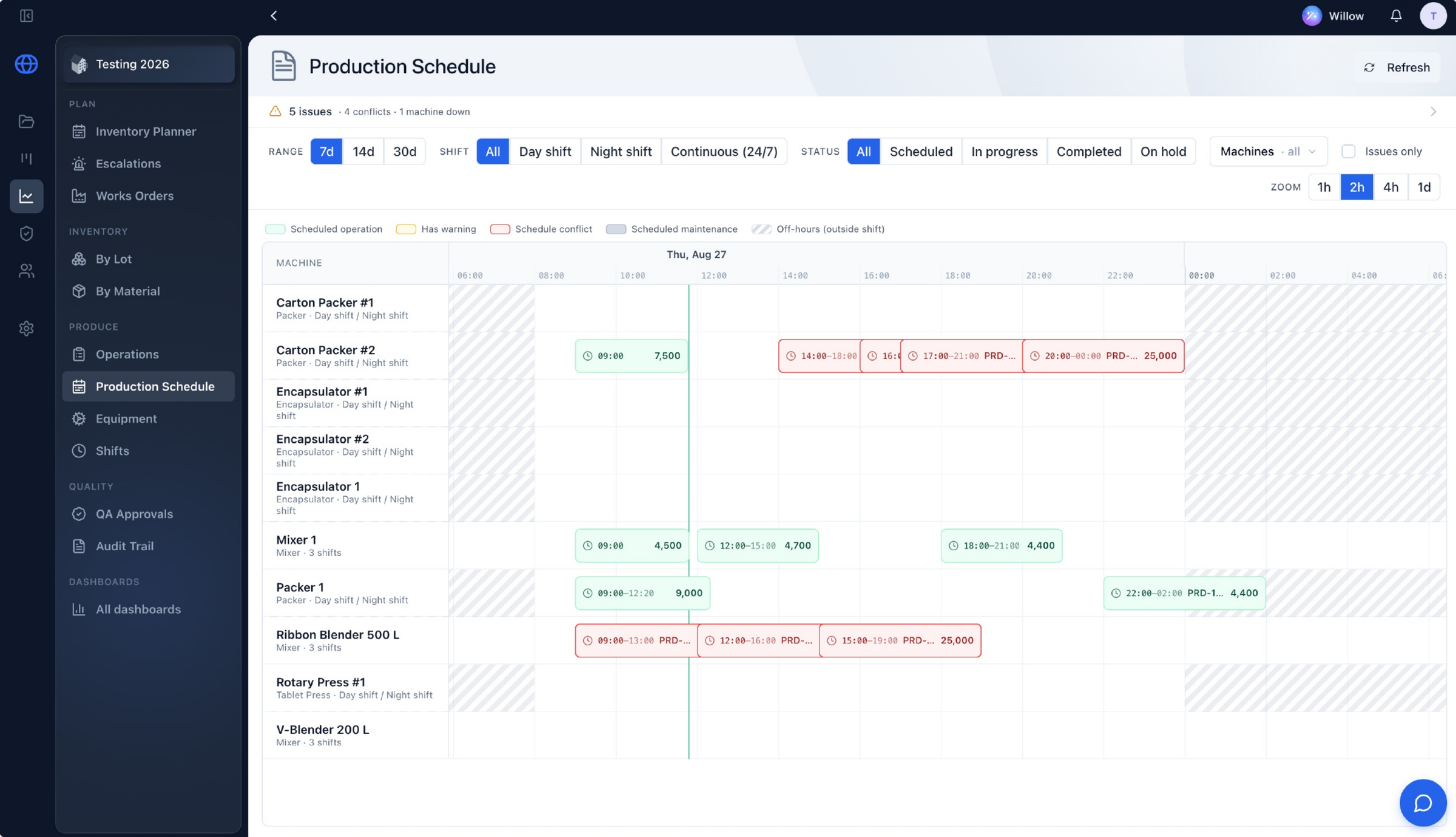
Usable stock, supplier lead times, equipment and shifts determine what's feasible, before you promise the date. A solvent delivery slips while three grades share a vessel. See which campaigns and orders depend on it, check usable part-drums, and review a revised sequence with the cleaning time and customer commitments in view.
Buying and production move together.
Purchase proposals and manufacturing jobs connect to the same customer commitment. Consumption and yields are recorded against the plan.
The batch earns its release.
QC evidence and release decisions stay linked to the batch and order. A completed batch isn't shippable until quality releases it.
MRP · Planning and production
A revised order, delayed delivery or changed yield stays connected to the affected jobs, material requirements and customer commitments.
Explore MRPERP · Orders, purchasing and inventory
A receipt doesn't make a quarantined lot available. Purchasing sees the shortfall, planning sees the constraint and sales can review the customer date. Keep your finance system where it makes sense.
Explore ERPBuild your setup
Start with MRP: production planning and inventory. Build the wider operation around it with ERP, batch execution, R&D, PLM, quality and regulatory. The same product and lot records follow the work from brief to released batch.
Making and moving the product. Batch execution, planning, stock and the warehouse.
Plan vessel capacity, campaign order and cleaning sequences from material availability and released lots.
See usable part-drums of solvent by lot and quality status before purchasing more, with live supplier pricing.
Capture charge weights, actual yields and lot history on the batch record, with in-process checks and release approvals.
Turn customer demand by grade and delivery format into material requirements and production campaigns.
See it for chemicals manufacturersTrack drums, IBCs and bulk stock through receipt, storage, picking and dispatch with scanned lot movements.
See it for chemicals manufacturersThe product and formulation foundation. Where most customers start, because everything else reads from it.
Versioned substances, mixtures and specifications, with every affected batch and document linked to a composition change.
Blend trials, raw material compositions, impurities and live costs, with regulatory screening before scale-up.
Deviations, CAPA, change control and approvals linked to batch evidence, supplier qualifications and the audit trail.
See it for chemicals manufacturersQC results and certificates of analysis linked to the lot, specification and release decision.
See it for chemicals manufacturersClassify mixtures and author multi-language SDSs from live composition, with CLP/GHS labels and reissue on change.
The financial backbone, running on the same substance-aware records.
Orders, purchasing and finance on the same substance and lot records as production and dispatch.
See it for chemicals manufacturersCompare quoted and actual margins using raw material costs, charge weights, yield and delivery costs.
See it for chemicals manufacturersWhat we wouldn't sell you
Your setup
What it connects
Substance data, formulations, classification, safety data sheets and the versions customers have already been sent.
How the workflow changes
Documents are generated from the live composition rather than retyped, so a raw material change reissues the affected sheets instead of leaving old versions in customers' hands.
Scope note
Scientific simulation and molecular modelling are out of scope; the focus is operational chemical management.
Take this setup with you
Get your setup as a PDF.
The modules you've selected, what each one covers and how they connect, written up as a document you can share internally.
Worldover supports connected regulatory workflows, product documentation, approvals and the operational data behind them. It isn't a regulatory consultancy service.
Willow finds answers, prepares work and routes decisions using the live operating record. Material actions remain governed by permissions, approvals and audit history.
6 selected
See your setupWillow
Willow works from your orders, formulas, usable stock, supplier data and batches. It flags planning issues, prepares buying and production work, and helps quality and regulatory teams respond, with your people approving the decisions.
Checks the plan
Finds the material, capacity or release constraint behind an affected job or customer order.
Prepares the work
Prepares purchase proposals and manufacturing jobs from the current formula, usable stock and supplier context.
Connects the response
Drafts the QC follow-up, document update or customer reply against the affected records.
Gets approved
Scoped permissions, human approval for anything material and a full audit trail of every action.
Tell us where the friction sits today and we'll map the Worldover setup that removes it.
Common questions
The substance record links to every mixture, classification, SDS, batch, stock lot and customer, so the impact list is produced in a search rather than assembled by hand.
Classification runs from the current composition, so CLP and GHS outcomes, labels and hazard statements are recalculated against the change instead of being rechecked manually.
Worldover holds which version of which SDS went to which customer, so reissues and customer notifications are generated from the record.
Lot level data connects composition, test results, release status and market obligations, so you can see which lots remain sellable and where.
Yes. Own-product manufacturers manage their portfolio, production campaigns and market obligations. Toll and contract manufacturers also manage customer-owned recipes, briefs and quotes, with permissions keeping each customer's IP separate. Both work from the same substance, batch and lot record.
Yes. Start with composition, classification and SDS authoring, then connect quality, planning and operations as needed. Your existing ERP can stay in place while the agreed integrations keep product and operational records aligned.
QC results sit against the lot and its agreed specification. Certificates of analysis are generated from those results rather than retyped, with release approvals and lot history kept on the same record.
Check whether the system connects formulations, charge weights, expected and actual yields, lot inventory, QC results and certificates of analysis to orders and production. Worldover adds R&D, regulatory and SDS authoring to that operational record rather than keeping chemical data in attachments.
Yes, Worldover can bring material requirements, purchasing, manufacturing jobs and stock onto one record. Your team reviews the plan and release decisions, and existing finance or specialist systems can remain connected where needed.
Yes. The operating record can connect customer specifications and commitments for toll and contract work, or your own formulations and portfolio for own-product manufacturing. Drums, IBCs, bulk orders and their lot and document history stay in context.
Chemical manufacturers need production planning (MRP or ERP) that understands recipes, yields and by-products, quality and LIMS data tied to the lot, and regulatory tooling for REACH registration, CLP classification, SDS authoring and poison centre notifications. The deciding factor is whether classification and labelling update automatically when a raw material or composition changes.
You keep SDSs current by authoring them from the substance and composition record rather than editing documents, so a change to a raw material re-triggers classification, regenerates every affected language and market version, and flags which customers received the superseded version. Manual document control is where most multi-market SDS programmes fail.
Generic ERP handles the money and the stock but usually not potency, variable yields, co-products or quality holds, so planners rebuild the schedule in spreadsheets. Chemical production planning needs the formulation, quality status and regulatory status of a lot in the same model as the plan.