MRP · Planning and production
Carry the plan into the batch.
A revised order, delayed delivery or changed yield stays connected to the affected jobs, material requirements and customer commitments.
Explore MRP
Manufacturers · Supplements
Formulation, potency, testing and label stay aligned, so you can ship faster without breaking the claim.
The label says 500mg at end of shelf life, and the only evidence of the overage that makes that true is a spreadsheet.
Active potency varies by lot, the overage was set once, stability runs for months, and the label claim was signed off before any of it settled.
You either over-dose actives you don't need to and give away margin, or under-dose and can't evidence the claim when a retailer or regulator asks.
Worldover connects the formulation, overage, incoming potency, stability results, label claim and cost on one product record.
The claim on the label is evidenced by the data behind it.
MRP is the starting point, not the whole system
Plan what production will really consume. Worldover MRP connects approved formulations, potency, overage, yield, expiry and line capacity, so blending, encapsulation, tableting and packing share one workable plan.
An order becomes a plan.
Orders and demand become production requirements from the approved formula and BOM. A revised order stays connected to the affected jobs and material requirements.
Stock and capacity are checked.
Usable stock, supplier lead times, equipment and shifts determine what's feasible, before you promise the date. Two customers need the same active and the same bottling line. Calculate requirements with assay and overage, check which lots remain usable on the run date, and review both orders against the available packing capacity.
Buying and production move together.
Purchase proposals and manufacturing jobs connect to the same customer commitment. Consumption and yields are recorded against the plan.
The batch earns its release.
QC evidence and release decisions stay linked to the batch and order. A completed batch isn't shippable until quality releases it.
MRP · Planning and production
A revised order, delayed delivery or changed yield stays connected to the affected jobs, material requirements and customer commitments.
Explore MRPERP · Orders, purchasing and inventory
A receipt doesn't make a quarantined lot available. Purchasing sees the shortfall, planning sees the constraint and sales can review the customer date. Keep your finance system where it makes sense.
Explore ERPBuild your setup
Start with MRP: production planning and inventory. Build the wider operation around it with ERP, batch execution, R&D, PLM, quality and regulatory. The same product and lot records follow the work from brief to released batch.
Making and moving the product. Batch execution, planning, stock and the warehouse.
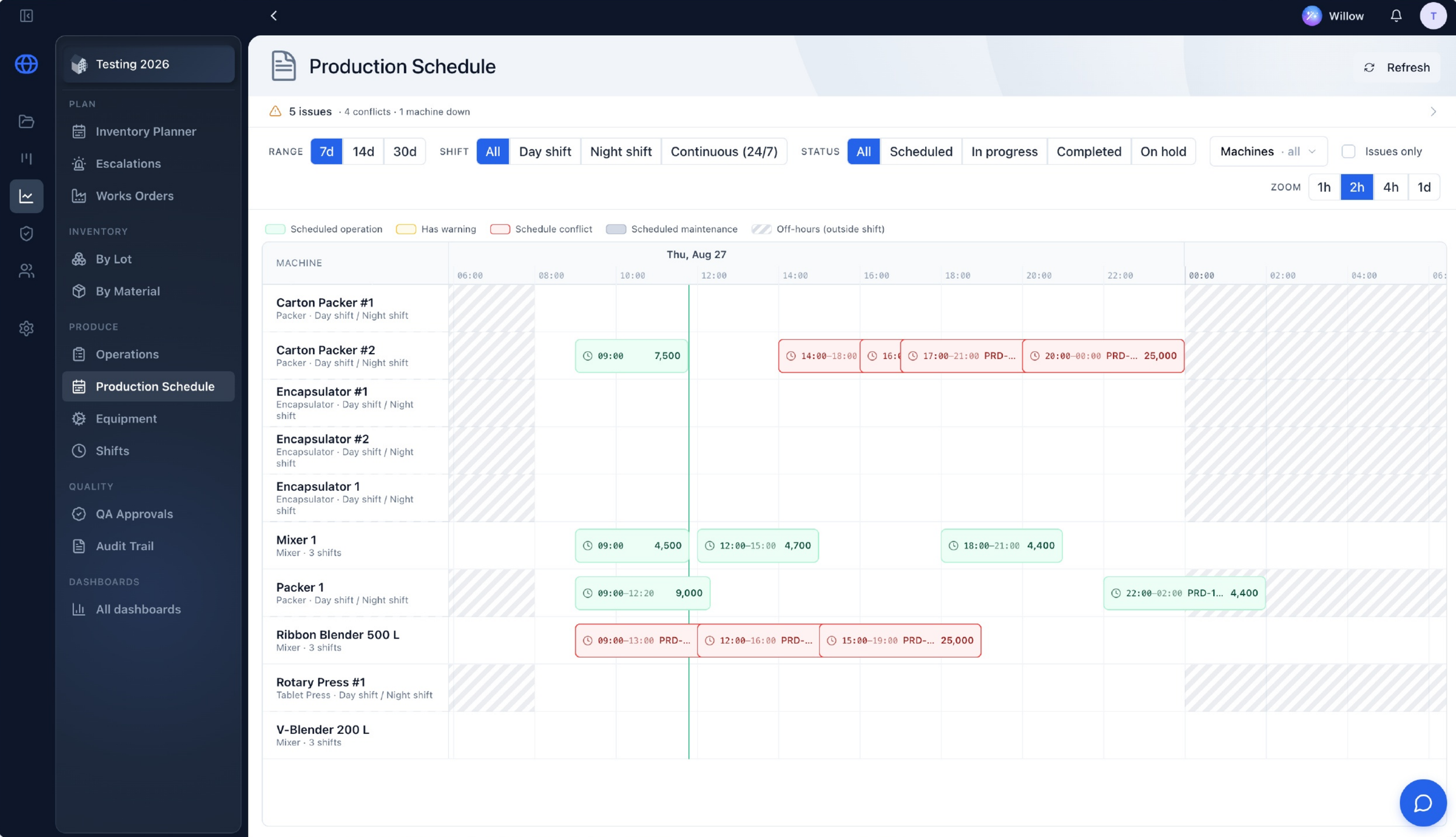
Scheduling from real machine, labour and material availability, with allergen-based sequencing for changeovers.
Stock, purchasing and supplier management in one place, with AI order-quantity recommendations across MOQs and pack sizes.
Electronic batch records with in-process checks, dual signatures and lot traceability, because a failed batch is the whole vessel.
Forecast from real sell-through and feed proposed manufacturing jobs straight into the plan.
See it for supplements manufacturersLocations, scanned movements and FEFO picking, so expiries don't become write-offs.
See it for supplements manufacturersThe product and formulation foundation. Where most customers start, because everything else reads from it.
The product record with a full BOM across formulation, components and artwork, so a change is assessed before it reaches the floor.
Formulations with live cost, regulatory screening and generated declarations, rather than a cost sheet built last quarter.
Change control, CAPA, training and document control with 21 CFR Part 11 records.
See it for supplements manufacturersProtocols, schedules and results feeding the release decision directly, so batches stop waiting on a spreadsheet.
See it for supplements manufacturersThe financial backbone, running on the same substance-aware records.
Finance on the same records as production, so cost per unit is a number rather than an estimate.
See it for supplements manufacturersBudgets, rolling forecasts, variance analysis and scenario planning built from live cost.
See it for supplements manufacturersWhat we wouldn't sell you
Your setup
What it connects
Briefs, stage-gates, formulation work, trials, approvals and the launch date behind them.
How the workflow changes
Every launch runs to a template with owners and gates, and the technical work sits inside it. Slippage shows up as a date on a project, not as a surprise in a meeting.
Scope note
Clinical trial management and dietary intake modelling are out of scope; the focus is operational supplement manufacturing.
Take this setup with you
Get your setup as a PDF.
The modules you've selected, what each one covers and how they connect, written up as a document you can share internally.
Worldover supports connected regulatory workflows, product documentation, approvals and the operational data behind them. It isn't a regulatory consultancy service.
Willow finds answers, prepares work and routes decisions using the live operating record. Material actions remain governed by permissions, approvals and audit history.
5 selected
See your setupWillow
Willow works from your orders, formulas, usable stock, supplier data and batches. It flags planning issues, prepares buying and production work, and helps quality and regulatory teams respond, with your people approving the decisions.
Checks the plan
Finds the material, capacity or release constraint behind an affected job or customer order.
Prepares the work
Prepares purchase proposals and manufacturing jobs from the current formula, usable stock and supplier context.
Connects the response
Drafts the QC follow-up, document update or customer reply against the affected records.
Gets approved
Scoped permissions, human approval for anything material and a full audit trail of every action.
Tell us where the friction sits today and we'll map the Worldover setup that removes it.
Common questions
Cost is built from live formulation inputs, labour and recorded yield, so the number reflects what the batch actually consumed rather than what the cost sheet assumed.
Lots are captured at the point of picking and held against the batch record, so forward and backward traceability for a recall is a query, not a reconstruction.
No. Own-product manufacturers usually start with the product record and the lab, then add planning, batch records and warehouse in sequence.
Yes. Input, output, residue, samples and losses are recorded against the works order, so the difference is visible and attributable rather than absorbed.
Supplement manufacturers need formulation and specification control with overage and potency handling, MRP for planning against actual assay results, quality management for GMP batch release, and label compliance for claims and nutrient declarations. The core requirement is that incoming assay results feed the batch calculation rather than being recorded after the fact.
Potency is handled by holding the label claim, the assay result for each incoming lot and the overage rule on the same record, so the quantity issued to a batch is calculated from the actual active content. Doing this in spreadsheets is the usual cause of failed release testing and rework.
FSMA 204 requires traceability records with key data elements at critical tracking events for listed foods, retrievable in a sortable electronic format within 24 hours of a request. In practice that means lot-level links from receipt through processing to dispatch, held as data rather than assembled from paperwork.