
Ingredient providers · Chemicals
Chemical ingredient supplier software, from grade to customer.
Worldover connects raw material records, R&D, regulatory and SDS authoring for chemical ingredient suppliers. Keep grades, specifications, lot CoAs, application trials and customer enquiries together, with evidence behind each technical answer.
Without Worldover
"Will your ingredient work in my emulsion at pH 5.5?" and the answer is in someone's head and an old lab book.
Application formulations drive the sale, but lab notebooks, tests, raw materials, regulatory checks and inventory rarely have a home, and composition with impurities at ppm is kept accurate by hand.
- SDS management never stops: keeping them current, recording which version went to which customer, and telling those customers when it changes.
- EU REACH and UK REACH are two regimes with duplicated cost, on top of TSCA, K REACH, KKDIK, China notification and IECSC, each with its own thresholds and format.
- The SVHC candidate list updates roughly twice a year, and each update means working out which materials, mixtures and customers are affected inside a fixed window.
Sales waits on the lab, documentation packs get rebuilt by three teams, and a missed threshold or a stale SDS becomes a regulatory problem in an export market.
With Worldover
Worldover connects the applications lab, composition and impurity data, SDS authoring, registrations and the customer request in one record.
The technical answer and the documents behind it come from the same live data.
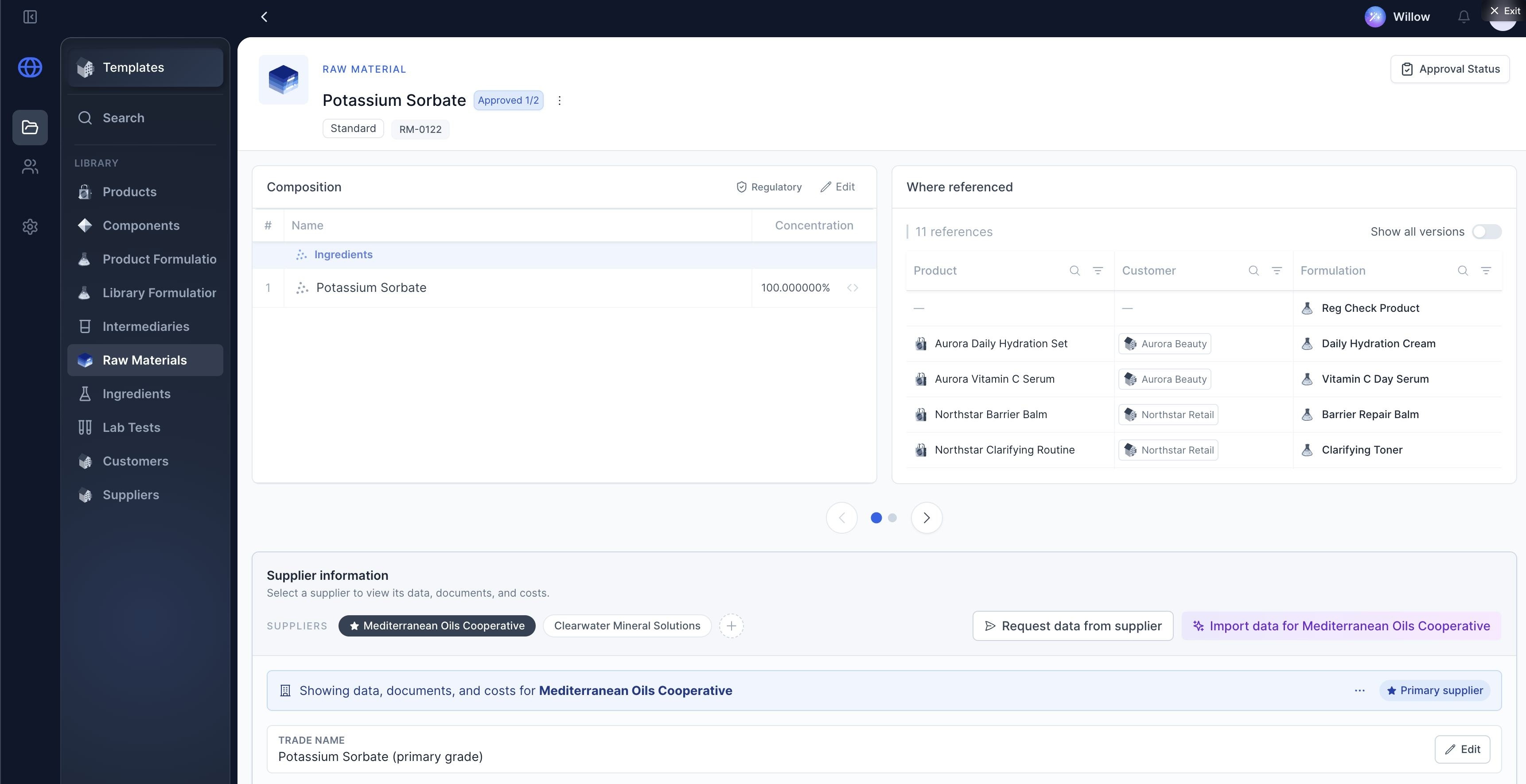
- One lab record covers raw materials, application formulations, trials and tests, with composition ranges and impurities at ppm held once.
- SDSs are authored automatically across languages and jurisdictions, with version control and a record of which version went to which customer.
- Registrations, inventory listings and tonnage bands are tracked per substance and legal entity, so you see the next band before you cross it.
Build your setup
These are the modules we typicallyoffer to chemicals ingredient providers.
Ingredient and chemicals producers lead with SDS authoring and the applications lab, because documentation and technical support are what actually sell the portfolio.
Starting from R&D and NPD. We've pre-selected the modules that function runs on. Add or remove anything below.
R&D / PLM
The product and formulation foundation. Where most customers start, because everything else reads from it.
SDS Authoring
Every chemical that changes hands needs an SDS, in the end user's language, across every jurisdiction. Generate and version them automatically.
See it for chemicals ingredient providersR&D Lab Software
The applications lab gets a home: raw materials, compositions with impurities at ppm, trials, tests and INCI mapping across markets.
- Raw materials workflow management
- Composition management
- Table management
QMS
Specifications, supplier approval, deviations, CAPA with effectiveness verification, and training records, which are the two most commonly failed audit items.
See it for chemicals ingredient providersCustomer Portals
Ends the document relay. Customers pull the SDS, CoA, statements and declarations themselves, under permission control.
- Permissioned sharing
- Product catalogue
- Catalogue search and filtering
PLM
The portfolio represented accurately, with every associated document and composition attached to the product.
- Products
- Product specific workflows
- Product table management
Testing Management
Protocols, results and approvals feeding batch release, including third-party results that currently live outside the system.
- Test protocol library
- Test scheduling
- Results management
AI Agents
Two-way document flow automated: chase supplier paperwork, extract and file it, then generate the packs customers ask for.
Add to your setupCRM
Enquiries, samples, technical questions and accounts connected to the product and regulatory records behind them.
See it for chemicals ingredient providersQuote Management
Pack sizes, volume tiers, currencies and incoterms quoted from live cost rather than a rebuilt spreadsheet.
See it for chemicals ingredient providersProject Management
Hundreds of application projects tracked against the lab work they depend on.
- Project templates
- Critical path and timelines
- Project list view
Supplier Portals
Suppliers maintain their own documentation, which is half the paperwork problem gone.
See it for chemicals ingredient providersPackaging Specification
Component specifications, recycled content tracking and EPR reporting.
Only if: You pack into your own containers and carry PPWR or EPR obligations.
See it for chemicals ingredient providersMRP / MES
Making and moving the product. Batch execution, planning, stock and the warehouse.
MES
Electronic batch records across mixing and finishing, with lot traceability you can prove in hours.
Add to your setupInventory Management
A catalogue-wide view of stock, with tiered supplier pricing history and scorecards behind every buying decision.
Add to your setupERP
The financial backbone, running on the same substance-aware records.
ERP
Finance and order management on the same substance-aware records.
See it for chemicals ingredient providersFP&A
Budgets, forecasts, variance analysis and scenario planning.
Only if: You're managing margin per material and reporting to a group or a board.
See it for chemicals ingredient providersYour setup
R&D Lab Software + PLM + Project Management + Testing Management + Customer Portals
What it connects
Briefs, stage-gates, formulation work, trials, approvals and the launch date behind them.
How the workflow changes
Every launch runs to a template with owners and gates, and the technical work sits inside it. Slippage shows up as a date on a project, not as a surprise in a meeting.
Scope note
No molecule discovery, drug discovery or scientific simulation.
Take this setup with you
Get your setup as a PDF.
The modules you've selected, what each one covers and how they connect, written up as a document you can share internally.
Worldover supports application development, formulation, technical service, product data and commercialisation. It doesn't sell fundamental scientific discovery.
Worldover supports connected regulatory workflows, product documentation, approvals and the operational data behind them. It isn't a regulatory consultancy service.
Willow finds answers, prepares work and routes decisions using the live operating record. Material actions remain governed by permissions, approvals and audit history.
5 selected
See your setupWillow
The AI colleague insideyour chemicals ingredient provider operation.
Because every workflow you pick above writes to one connected operating record, Willow can work from what's actually true today, not a copy of it.
Reads
Answers questions from your live formulas, documents, batches and customers.
Writes
Updates the record itself, drafting the formulation change or document and writing it back with its source and version.
Prepares
Drafts the document, the update or the reply so a person only has to check it.
Gets approved
Scoped permissions, human approval for anything material and a full audit trail of every action.
- 125+
- Enterprise customers across cosmetics, chemicals and supplements
- 4 to 7
- Point systems typically retired, most within 6 months of go-live
- 12 to 16 weeks
- To a live Phase 1, not a multi-year programme
- 1 record
- Per substance, everywhere it appears
Research
Compared with the alternatives
If you're still building a shortlist, these break the market down side by side.
- ShortlistBest chemical ERPs in 2026Ranked shortlist of chemical ERPs, with pricing bands and who each one suits.Read it
- GuideSDS authoring software buyer's guideWhat separates real SDS authoring from document templating.Read it
- ShortlistBest regulatory compliance software for chemicals in 2026REACH, CLP and SDS coverage compared across the main platforms.Read it
- ComparisonWorldover vs SpheraSDS and hazard management against a dedicated EHS suite.Read it
Book a 30-minute slot
Tell us where the friction sits today and we'll map the Worldover setup that removes it.
Common questions
What chemicals ingredient provider teamsask us most.
The questions that come up in nearly every conversation
How many jurisdictions does SDS authoring cover?
Authoring is multi-language and multi-jurisdiction, generated from composition and classification held once, with full version control and distribution history per customer.
Can it handle ranges, exact percentages and impurities?
Yes. Composition management supports ranges, exact percentages and impurities at ppm, and reuses that data across every document generated from it.
What happens when the SVHC candidate list updates?
You can see which materials, mixtures and customers are affected from the substance data you already hold, rather than starting a manual review.
Does the applications lab get its own workspace?
Yes. Mock and application formulations, trials, tests and samples run on the same record the commercial team works from, so technical answers reach the customer faster.
Chemicals ingredient providers: the questions people search
- How is ingredient supplier software different from distributor software?
- Ingredient suppliers need grade-level technical records, application trials and sample history alongside commercial enquiries. Distributors concentrate on orders, stock and dispatch documents. Worldover connects the relevant workflows without treating those businesses as the same audience.
- Can Worldover connect raw material specifications, SDSs and certificates of analysis?
- Yes. Specifications and SDSs connect to the substance and grade, while certificates of analysis connect to the lot's test results. Technical and commercial teams can work from the same evidence rather than separate document folders.
- What software do chemical distributors and ingredient providers need?
- Chemical ingredient providers need substance-level records covering registration status, classification and restrictions, SDS authoring in every required language and market format, lot-level certificates of analysis, and quoting linked to the same record. The commercial risk sits in the documentation, not the order entry.
- How do you confirm regulatory status of a substance in a customer's region?
- Confirming status means checking the substance against each territory's inventory and restriction list (EU and UK REACH, TSCA, K-REACH, IECSC and similar), the tonnage band registered, and any authorisation or restriction entries. Held as data against the substance, it becomes an instant answer rather than a research task.
- How should certificates of analysis be issued to customers?
- Certificates of analysis should be generated from the lot's actual test results against the agreed specification and issued automatically with dispatch, in the customer's required format. Retyping results into templates is the most common source of customer complaints and audit findings.